


IRELAND
Book Your Free ConsultationThe Republic of Ireland is located west of Great Britain and consists of 26 of the 32 counties of Ireland with the remaining 6 counties remaining part of the United Kingdom. Over the last 30 years the country has witnessed one of the greatest economic success stories anywhere in the world moving from a primarily agricultural economy to a knowledge-based economy with one of the most educated workforces in the world. It has become the EU base for virtually every major US multinational company but has also spawned its own set of multinationals including Stripe, CRH, Ryanair, Kingspan, Kerry Group etc. leading to it being the largest per capita investor into the USA employing some 200,000 US citizens. Socially the country has also witnessed dramatic change moving from a primarily conservative Catholic country to an ultra-liberal, multi-faith and multicultural society.
Population: 5,458,600 (2025) in the Republic and 1,927,855 (2024) in Northern Ireland. Total 7,386,455.
Size: 70,273 sq.km or 84,421 sq. km for the whole island.
Capital: Dublin
Economy: The economy is a highly developed knowledge-based economy focused on high-tech, life sciences, financial services, tourism and agrifood. In terms of GDP per capita 4th in the world according to the World Bank. It is however, a very open economy and dependent on international trade and consistent tariffs, things which the current US administration seems determined to compromise.

TAXATION – WHY & FOR WHOM?
WHY? The Republic of Ireland has long sought to be an attractive location for multi-national companies and has long been a competitor to the UK for inward investment. Now that the UK is leaving the EU and Ireland is remaining, the attractiveness of Ireland has been greatly increased not least for UK companies needing to maintain an EU presence but nonetheless in familiar surroundings. The reasons are many but include:
- Lack of bureaucracy – Compared to virtually all of Continental Europe Ireland, like the UK is remarkably free of business-related bureaucracy and is also a ‘hot bed’ of entrepreneurial activity.
- Companies can be formed in as little as 3 working days and have virtually no capitalization requirements.
- English is the main working language of Ireland.
- The Irish common law system is almost the same as that of the UK and is therefore considered to be much more business friendly than the slow and codified civil law system in Continental Europe.
- Dublin is a significant EU financial and services centre ranking only below Frankfurt and Paris.
- Corporate taxes are much lower than the EU norm at 15% and are unlikely to change in the near future.
- Individual taxation can be very advantageous for wealthy non-domiciled but Irish ordinarily resident individuals. In effect, this means that such people whilst protected by Irish tax treaties need only pay Irish taxes on those sums remitted or earned within the country.
- Dublin is a major communications hub for Europe and is the home base for the World’s largest airline Ryanair and the Irish Flag carrier Aer Lingus.
- The Irish economy is per capita one of the wealthiest in Europe outranking that of Germany and the United Kingdom by a significant margin.
FOR WHOM? Before Brexit the answer to this question was basically see all of the above! However, since the UK’s Brexit decision the need for individuals and/or companies previously content with trading from their home UK base to establish a genuine Irish presence has greatly increased. It is likely that as the UK diverges more and more from the current EU trading standard norms so too will the need for UK companies to establish an Irish presence.
IRISH COMPANY MANAGEMENT
Synopsis
The Irish economy has been one of the most robust within the EU with full employment and soaring corporate tax receipts leaving the Government with the enviable task of deciding what to do with a massive exchequer surplus of over €26 billion in 2023. Ireland also continues to proportionally attract more US inward investment than any other country in the world no doubt due to factors such as its continued low corporate tax rate of 15%, excellent communications, highly skilled workforce and very attractive domicile and residence distinctions for wealthy foreigners wishing to move to the Emerald Isle.
Finally, the country benefits from of one of Europe’s best negotiated double taxation treaty networks, full EU membership since 1973 and one of the best quality of life environments in Europe. The capital city is Dublin – literary home to Shaw, Joyce, Sheridan, O’Casey, Yeats – with the main industries being computer software, finance and tourism.
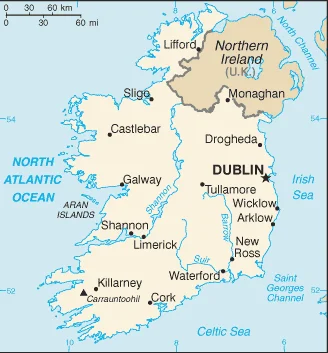
Location
The Republic of Ireland occupies around 80% of the Ireland of Ireland with the remained (Northern Ireland) being part of the United Kingdom. It is the 3rd largest European Island after Great Britain and Iceland.
Managed Limited Companies
The Ireland has excellent tax planning credentials, not only offering a highly competitive 15% corporate tax rate but some unique and very attractive personal tax benefits that make the country an ideal base for even small businesses and high paid tax consultants. Key to Ireland’s success is the fact that it has an excellent reputation and does not permit ‘mailbox’ operations meaning that all companies purporting to be managed in Ireland must indeed be managed from within the jurisdiction.

COMPANIES
Hong Kong uses the common law system and still employs company statutes based on English & Welsh Companies’ Acts dating back to 1948.
Double Taxation Treaty Network
The key benefit is that the Ireland has an extensive and very favourable tax treaty network and includes treaties with virtually every country in the World that is part of a tax treaty network. In addition, the Ireland’s EU membership also allows for the use of key EU Directives such as the Parent Subsidiary Directive 90/435 (which avoids any withholding taxes on intra EU dividend payments) and 03/49, which does the same for interest and loans within the Union.

ADMINISTRATION & ACCOUNTANCY SERVICES
Managed Irish Limited Liability Company
The key service offered by the SCF Accountancy & Law is that of a fully managed Irish company where-by we can register your Company, act as the daily legal and accountancy administrators, liaise on your behalf with the Revenue Commissioners, the Company Registration Office (CRO), maintain the registered office, company minutes and in fact everything necessary to provide you with a fully functional VAT registered Irish limited liability company including quarterly VAT returns, online banking, management and meeting rooms etc. – In fact, our Irish services are totally bespoke according to your needs.
IRISH CORPORATE & VAT RATES 2026
The Irish tax system is highly developed but relatively straightforward and efficient compared with many of its European counterparts. Like the UK, Ireland has some of the most developed company focused anti-avoidance provisions including ‘substance over form’ tests but nonetheless is still one of the most corporate friendly locations in Europe and if course a full and committed member of the European Union.
BASIC FACTS: In synopsis, the corporate tax rate in the Republic of Ireland is as follows:
STANDARD COMPANY RATES OF TAX
15% Corporate Tax based on a Calendar Year Basis, or 25% for non-trading activities
CAPITAL GAINS TAX
The rate of capital gains tax for companies is 33%
VALUE ADDED TAX (Variable Rates)
In simple terms, VAT is a tax levied upon consumer expenditure. It does not, at least for VAT registered undertakings; apply to transactions carried out in the course of business. However, to ensure the extraction of the tax, all suppliers of applicable goods and/or services must charge VAT which can then be reclaimed by the receiving VAT registered entity. If further sales are made, then the process is simply extrapolated until, if appropriate, an end consumer is found.
The Main Irish VAT rates are as follows:
- 0% (the zero rate).
- 4.8% (the agricultural rate). This applies to supplies of live cattle, deer, goats, greyhounds, horses, pigs and sheep.
- 13.5% (the low rate). This is reduced to 9% for certain goods and services.
- 23% (the standard rate). This rate applies to goods and services that are not exempt, or specifically liable at 0%, 4.8%, or 13.5%.
For more information on Irish Company Formation services, please speak to a tax planning consultant